


Posted by Lisa Neatham
on August 07, 2025
Getting toys out of sight in a living room without making the whole space feel like a playroom is one of those things that sounds simple but takes a bit of thought. The trick is choosing storage that earns its place in the room, pieces that look intentional, work hard, and don't shout "children live here" the moment an adult walks in.
Here's what works, based on real family experience with GLTC's range.
My own children - aged 7 and 9 - have been off school for a week now and while they're not outwardly worried by the news, I've noticed that they're increasingly keen to be close by. It's meant finding a happy medium where I can get some work done but still be on hand for a bit of reassurance should they need me.

As a result, a couple of days ago, I made the decision to reshuffle the furniture and say a temporary farewell to the bar cart that normally resides in the corner of our living room and instead welcome the Alba Playroom Storage that normally lives in our hallway. While this family room was once a relatively toy and work-free zone, it's now become the place where the boys play while I tap away at my laptop.
I've worked for, and been a customer of, Great Little Trading Co. for a few years now, so as you can probably imagine, I have quite a few products dotted around my house. This little play corner that I've created combines some of my favourites, and here's why I chose them.
THE GOLDEN RULE: STORAGE THAT LOOKS LIKE FURNITURE, NOT STORAGE
The biggest mistake with living room toy storage is buying something that looks like it belongs in a playroom. Bright primary colours, obvious toy box lids, plastic bins, they work brilliantly in a bedroom or playroom, but they stand out in a living room in all the wrong ways.
The pieces that work best in a shared family space are the ones that could pass for grown-up furniture. A modular unit that looks like a sideboard. Rope baskets that sit on a shelf like décor. A wool rug that defines a play zone without announcing it.
Below are the storage solutions that hit that balance, and why they work.
MODULAR STORAGE UNITS: THE MOST FLEXIBLE OPTION
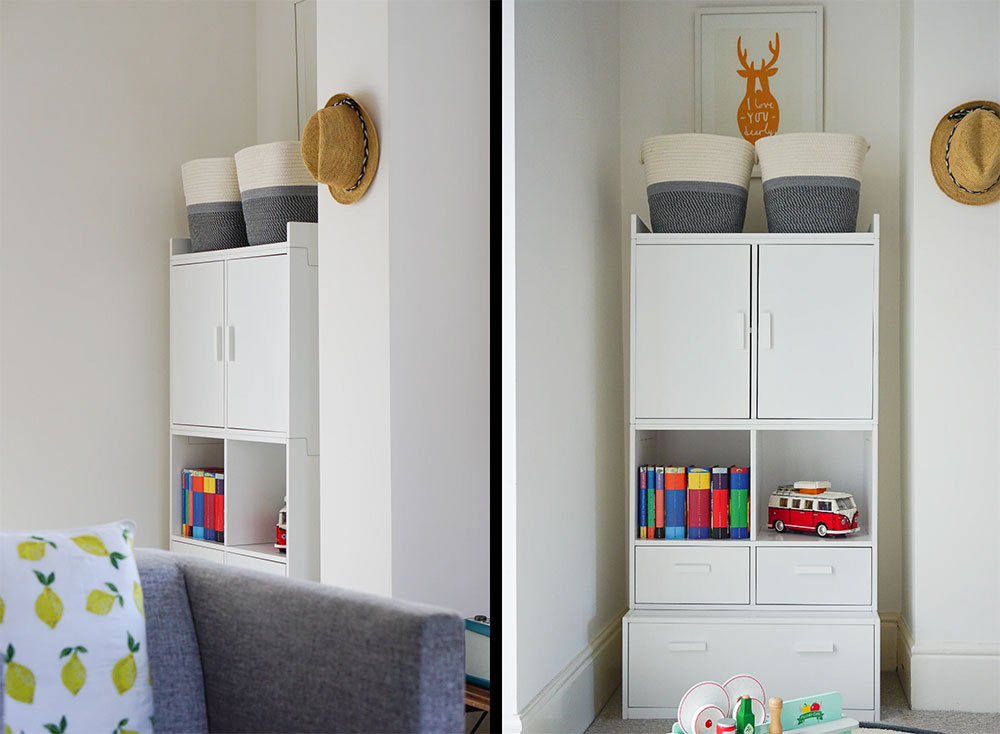
Launched in Autumn 2019, I was quick to buy several pieces from the Alba Playroom Storage range to keep the tidal wave of toys from taking over our home. The boys love Lego, cars, arts and crafts, and books, so we tend to have lots of little bits and pieces, partly-constructed builds and colouring pencils around the house that need a home at the end of every day.
A modular storage unit is the most versatile choice for a living room because you can configure it to fit the space rather than working around a fixed size. Rachel, who has two boys aged 7 and 9, uses GLTC's Alba Playroom Storage range for exactly this reason:
I chose the Alba range for several reason reasons:
- There are multiple pieces in the range and they slot together in a multitude of ways. It means that, once you've measured the space you have available, you can basically configure a bespoke storage unit.
- The mix of closed compartments and open spaces enables you to shut the doors and not feel like everything has to be neatly arranged.
- The design is really, really neat so the units don't scream 'TOY STORAGE'. Alba is so chic and simple, it can be used in any room of the house.
- Should you wish, you can add colour and character with GLTC's Storage Cubes and Baskets.
- Modular storage offers extra flexibility. If you want to add additional units, you can. If you’d like to rearrange the units or separate them, it’s entirely doable.
The closed compartments are the key detail for a living room, you can shut the doors at the end of the day and the room feels like yours again. Browse modular storage.

I didn't buy the toy storage specifically for this spot in my living room but for all the reasons above, it's slotted in seamlessly and almost looks like it's been made for the space. They boys have a lot of their toys to hand now but my living room doesn't feel like it's been transformed in to a playroom. And the Kids' Toy Box Base? The amount of Lego it holds is incredible. It's so roomy.

STRONG AND STYLISH STORAGE BASKETS

I love GLTC's rope storage baskets. The canvas cubes with their colourful designs are brilliant for children's bedrooms and playrooms but I really like the muted colour palettes of the rope baskets for more grown up spaces. I chose the Grey Belted ones for my living room. They might be filled with a whole ton of toys but from the outside, they look chic and stylish. They can be popped on top of the storage unit - or in one of the open compartments if you don't want to have any toys or books on show.
Baskets work well in a living room because they're genuinely portable, scoop everything in at the end of the day, put the basket back on the shelf, and the room resets in under a minute. For the living room, rope or woven baskets in neutral tones sit on shelves or on top of a storage unit without drawing the eye. Save the brighter canvas cubes for bedrooms and playrooms where colour fits more naturally.
A practical tip: keep one basket per category rather than mixing everything together. Lego in one, cars in another, books in a third. Children can find what they want without tipping everything out, and tidying up is quicker because everything has a clear home.
CHILD-FRIENDLY RUGS THAT ARE EASY ON THE EYE

I'm a huge fan of rugs. They help to create little zones within rooms and add a layer of warmth when you live in an old house, as we do. GLTC's rugs feel extra luxurious because they're made from 100% pure wool. They're incredibly soft for children to play on.
While I personally think the On The Road Rug is the best children's rug I've ever come across, for a family room, you can't go wrong with the neutral Berber Rug for creating a small play area. And the charcoal detailing ties in really nicely with the rope baskets, don't you think?
See more of our Shared Spaces for inspiration.

Defining a play zone with a rug is one of the most effective things you can do in an open-plan or large living room. It gives children a clear sense of where their space is, which actually helps with tidying because the boundary is physical, not just a rule. When the toys go back in the basket at the end of the day, the rug still looks intentional.
FEW THINGS THAT MAKE A BIG DIFFERENCE
Beyond the specific pieces, a few habits make living room toy storage genuinely work long-term:
Toy rotation keeps the volume manageable. Not everything needs to be accessible all the time, storing half the toys away and swapping them every few weeks means less clutter to deal with daily, and children often play better with fewer things in front of them. Read our toy rotation guide.
Keep it accessible for children. Storage that children can use independently means they can help tidy up. Baskets and open cubes at low height are the key, if they have to ask for help to reach it, they won't put things away themselves.
Fewer, better storage pieces beat more of the wrong ones. A well-chosen modular unit that fits the space properly does more work than four different storage solutions that don't quite go together.
For more ideas on keeping shared spaces working for the whole family, have a look at our toy storage for small spaces guide or browse the full toy storage range.
